


Important Data Entry Insight
One of the biggest beginner mistakes is assuming every piece of information should be typed exactly as received. Professional data entry specialists first verify that the information follows the required format before saving it. This process is called data validation, and it is one of the most valuable skills in today’s workplace.
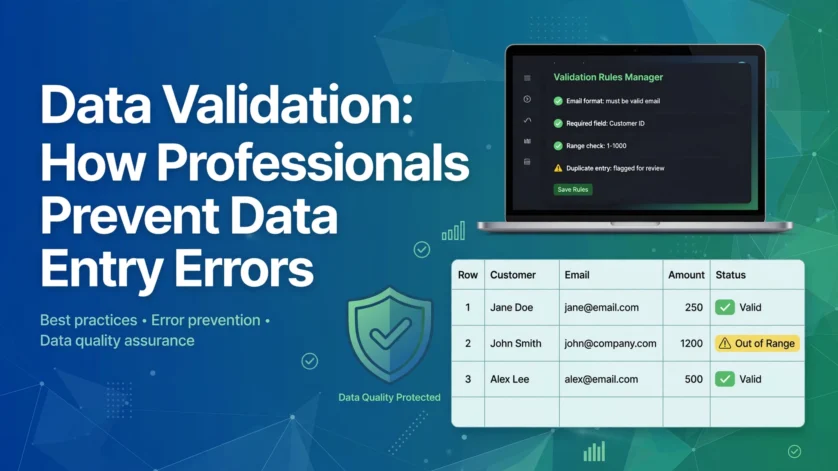
Data validation is the process of checking information before it is accepted into a spreadsheet or database. Instead of allowing inconsistent or incorrect entries, professionals create rules that help maintain clean, reliable records.
For example, imagine a company stores customer countries. One employee types USA, another enters United States, while someone else writes U.S.. Although they all refer to the same country, inconsistent entries make reporting and analysis much more difficult.
Professional data entry teams reduce these issues by validating data before it becomes part of the database.
Common data validation practices include:
- Using dropdown lists instead of free typing.
- Restricting dates to a specific format.
- Accepting only valid email address formats.
- Limiting numerical fields to realistic values.
- Preventing duplicate records whenever possible.
How to apply Data Validation in Microsoft Excel:
- Select the cells where users will enter information.
- Open the Data tab.
- Click Data Validation.
- Choose the appropriate validation type such as List, Whole Number, Date, or Text Length.
- Create the validation rule.
- Test the cell by entering both valid and invalid values.
- Save the workbook after confirming the rules work correctly.
These simple validation rules significantly reduce typing errors and make spreadsheets easier to maintain over time.
Senior Data Professional Insight
Beginners often correct mistakes after they happen. Experienced professionals design systems that prevent mistakes from happening in the first place. Data validation is not about limiting users—it is about protecting the integrity of business information. Accurate data saves time, improves reporting, and reduces costly corrections later.
Our training focuses on developing structured thinking, building reliable accuracy systems, understanding real business workflows, and practicing professional data habits. These principles help learners move beyond simple typing and develop the mindset employers value in modern data operations.
Want to become a professional data entry specialist?
Join the Data Entry Training & Certification Community where beginners learn real data workflows, spreadsheet systems, and remote work skills step-by-step.
Join the WhatsApp Training GroupUnderstanding structured data thinking is what transforms simple typing into professional data work.
Most data entry mistakes happen because structure is never explained clearly. When you learn to validate data before it enters a system, you improve accuracy, strengthen business records, and develop the habits of a true data professional.